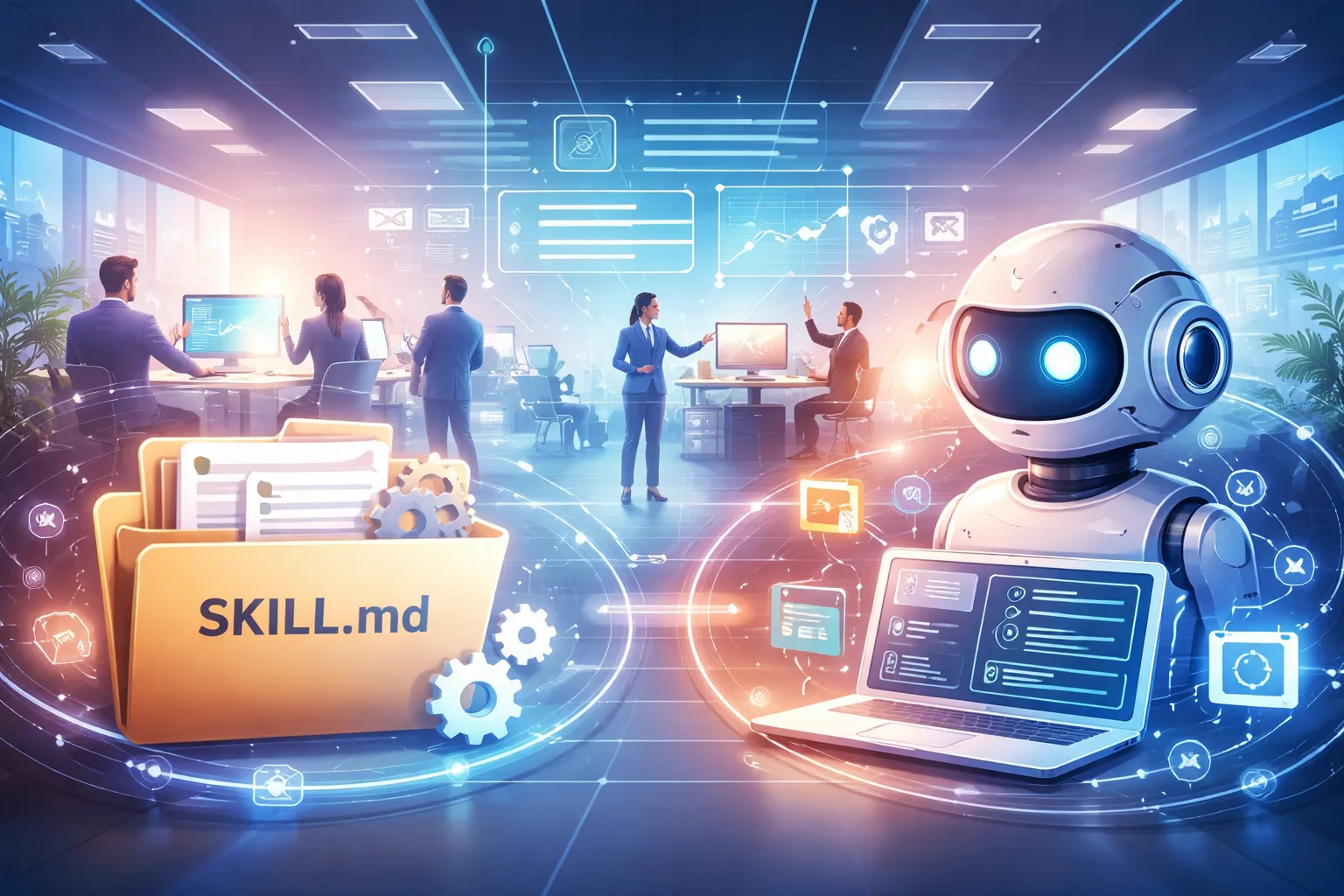
In recent months, a new wave of discourse has started circulating in the universe of artificial intelligence applied to work: the idea that files like SKILL.md have “replaced” AI agents. The phrase is catchy, makes for posts, videos, threads, and, of course, sells well. But technically, it oversimplifies a scenario that is richer — and more strategic — than it seems.
What is actually happening in practice is something else: modern tools have started allowing teams to package instructions, processes, references, and small operational flows into reusable structures called skills. In OpenAI’s official documentation, a skill is a versioned package of files anchored by a SKILL.md, used to encode conventions, processes, and repeatable flows. The system starts with the skill’s metadata and only loads the full content when it decides to use it, which improves context efficiency.
This is powerful. But it is not the same as an agent.
What a skill really does
A skill functions as a reusable block of operational intelligence. Instead of repeating the same prompt ten times, the team packages that procedure in a standardized format: instructions, scope of use, references, and, in some cases, auxiliary scripts. OpenAI itself recommends turning repetitive work into skills precisely to avoid long prompts and redundant interactions.
In simple terms, the skill answers the question:
“How should this type of task always be performed whenever it appears?”
It is excellent for standardizing code review, documentation generation, recurring audits, editorial styles, QA routines, compliance checks, and flows that happen many times within the same technical or organizational context.
What an agent does — and why this remains different
An agent operates on another level. It is not just a package of instructions. It is the piece that decides, coordinates, uses tools, manages context, and drives a task toward a goal. OpenAI’s documentation clearly differentiates these layers: AGENTS.md contains persistent instructions for the project; skills encapsulate expertise and workflows; and the use with SDKs or MCP enters the field of broader execution and orchestration.
In Anthropic’s ecosystem, the separation also appears quite clearly: there is specific documentation for subagents, which perform specialized delegation, and for hooks, which automate actions at specific points in the execution cycle. This shows that the more advanced market is organizing these capabilities as complementary pieces — not as synonyms.
In other words:
-
skill organizes operational knowledge;
-
agent executes operational strategy.
One can strengthen the other. But one does not automatically become the other.
So why are so many people saying “skills replace agents”?
Because, in many cases, what had been called an “agent” was just a large prompt, some persistent context, and a fancy name.
This is the point that almost no one discusses with the proper technical detachment.
Many “agents” presented in the market had no real planning, no robust orchestration, no exception handling, nor consistent use of tools. They were, in practice, a well-packaged layer of instructions. In these cases, yes: a well-built skill can replace that pseudo-agent with advantage, less noise, and more governance.
But when we talk about a real agent — capable of breaking a problem into steps, delegating subtasks, calling external tools, validating results, and following through to completion — the story changes. Anthropic itself describes its Agent SDK as a way to build production agents that read files, execute commands, search the web, edit code, and maintain a complete agentic loop.
This is well beyond a SKILL.md.
The most useful comparison for companies
For those leading teams, technology, marketing, or operations, the best way to understand is this:
Skill is procedure.
Agent is operator.
The skill documents and standardizes.
The agent interprets the goal, chooses the path, activates resources, and delivers results.
If your company wants to:
-
standardize recurring tasks,
-
preserve know-how,
-
reduce rework,
-
improve consistency between people and machines,
skills can generate quick value.
If the company wants to:
-
automate multi-step flows,
-
integrate systems,
-
handle exceptions,
-
combine decision + execution + validation,
-
operate at scale with controlled autonomy,
the conversation already enters the territory of agents, orchestration, and architecture.
The most common strategic mistake
The biggest mistake today is not “using too many skills” or “using too many agents.”
The biggest mistake is trying to solve everything with the same hammer.
There are companies trying to build complex agentic architectures when they have not even consolidated their own internal processes yet. In this scenario, AI only automates chaos. On the other hand, there are teams treating every problem as if writing a SKILL.md were enough, when the real demand requires operational memory, integration with tools, business rules, and decision-making capacity in flow.
The mature path usually goes through three layers:
-
Persistent instructions to align behavior and project context;
-
Skills to package recurring routines and expertise;
-
Agents and orchestration when the process needs to act, decide, and integrate.
What this changes in practice for businesses
It changes almost everything.
Because the discussion stops being “which buzzword is in fashion?” and becomes:
which architecture delivers productivity, governance, and scale without creating a futuristic hack that no one maintains six months from now?
This is the kind of question that differentiates experimentation from maturity.
Companies that understand this distinction tend to build more sustainable AI stacks. They use skills to capture knowledge and replicate quality. And they use agents only when they really need operational autonomy and coordination between tools. The result is less invisible cost, less improvisation, and more clarity about where AI is actually helping.
The point that deserves to be said explicitly
SKILL.md did not kill agents.
What it killed, in many cases, was the illusion that any prompt dressed up fancily was already an agent.
And frankly, it was about time.
Conclusion
The AI market is entering a more serious phase. Less dazzlement with labels. More attention to architecture, governance, and real applicability.
Skills are an extremely valuable piece of this new phase. They help transform tacit knowledge into reusable processes, with more consistency and less context waste. But agents still have their place when the task requires decision-making, coordination, and execution in flow.
For companies, the correct question is not whether one “replaces” the other.
The correct question is: which combination makes sense for the stage of your business, your team, and your operation?
That is where the difference lies between adopting AI as a trend and using AI as a competitive advantage.
How Descomplica can help
Not every company needs to start by creating a complete ecosystem of agents in the first step. In many cases, the smartest gain starts with organizing knowledge, standardizing flows, and defining where automation really generates return.
Descomplica works precisely at this bridge between strategy, communication, technology, and practical implementation — helping brands and operations understand where a skill solves, where an agent makes sense, and where the best path is still to design the process before automating.
Because, in the end, good AI is not the one that looks most futuristic.
It is the one that works in the real world.