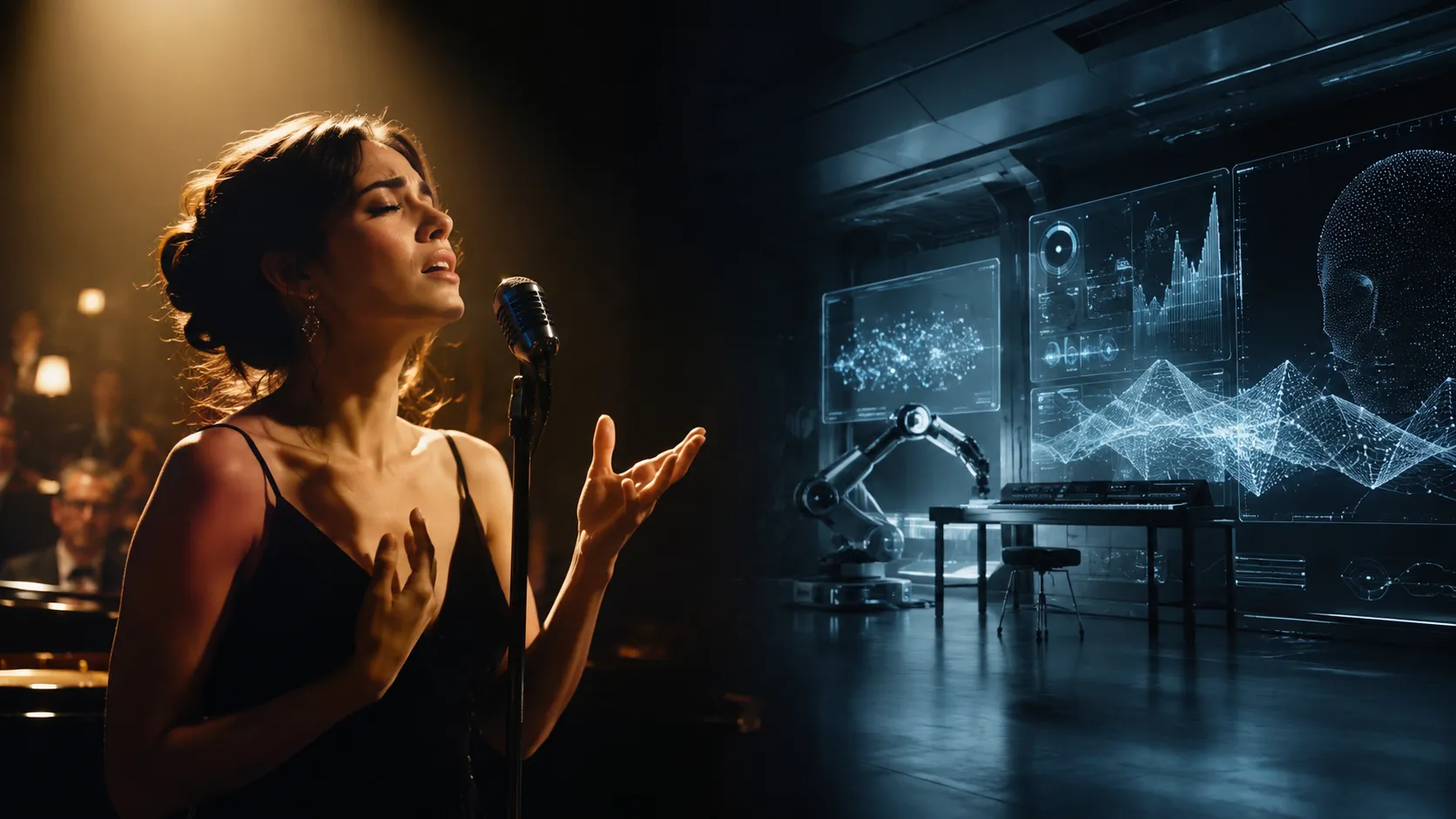
There is a growing confusion in the debate about artificial intelligence: the idea that those who work with AI, use AI, or advocate for the strategic use of the technology must automatically accept anything made by AI.
That's not quite the case.
Using artificial intelligence to write better, organize ideas, speed up processes, test creative paths, or expand production capacity does not mean wanting to listen to an artificial singer, watch a film entirely generated by machines, or consume works where voice, face, body, emotion, and interpretation have been replaced by simulation.
There is a huge difference between using AI as a tool and handing over the place of human experience to it.
And perhaps it is precisely those who work with technology who can best perceive this difference.
AI as a tool is power. As a total substitute, it becomes emptiness
Artificial intelligence is one of the most impressive tools ever placed in the hands of professionals in communication, marketing, creation, education, business, and technology.
It helps structure ideas, find paths, summarize information, generate versions, organize reasoning, automate tasks, and speed up processes that used to consume hours of work.
In this sense, AI does not diminish the human. It expands it.
The problem begins when technology stops being a means and starts wanting to take the place of everything: the composer, the singer, the actor, the director, the screenwriter, the editor, the photographer, the interpreter, the gesture, the mistake, the improvisation, the sweat.
When this happens, the work may even be technically correct. It may have good image, good sound, rhythm, aesthetics, and finish.
But something is missing.
Life is missing.
And life, as far as we know, does not yet come in a prompt.
Writing has always been collaboration. Presence has not
Many famous songs were not written by those who sing them. Many idolized singers never composed their biggest hits. In cinema, scripts go through many hands. In advertising, campaigns are built by copywriters, art directors, strategists, account managers, clients, and producers.
Creation has always involved collaboration.
Therefore, there is nothing strange about using AI to help write a lyric, a script, a dialogue, a concept, or a campaign. The written word is often a structure that still needs to gain body.
The central point is precisely this: to gain body.
A song transforms when someone sings it. A script transforms when someone interprets it. A text transforms when someone supports an idea with presence, experience, and intention.
Interpretation gives biography to the work.
A singer may not have written the lyrics, but when they sing, they put their breath, their timbre, their story, their pains, their habits, their technique, and their imperfections into it. An actor may not have written the script, but they lend their body, gaze, timing of pauses, and scene energy.
That is why a live performance matters.
That is why an acoustic version moves us.
That is why a show is not just the reproduction of a song.
It is a meeting.
The audience does not seek only perfection. It seeks truth
For a long time, part of technology moved as if the ultimate goal was to eliminate flaws. The perfect image. The perfect voice. The perfect cut. The perfect scene. The flawless performance.
But human culture has never been driven solely by perfection.
In fact, often it is the opposite.
What holds us to a work is precisely what seems to escape control: a voice that cracks at just the right moment, an actor who holds a silence for half a second longer, a musician who improvises, a difficult scene performed by a real person, an interview where emotion breaks through the speech.
Imperfection is not a defect. Often, it is a signature.
When everything is generated, predicted, polished, and simulated, the experience may impress in the first few seconds. But then a strange feeling arises: that it cost no one anything.
And art, communication, and entertainment carry value precisely because they cost something.
They cost time. Experience. Technique. Repertoire. Courage. Exposure. Risk.
The case of cinema: the body still matters
In cinema, this discussion becomes even more evident.
Part of the magic of watching an action scene is knowing that there is a human body there, even if surrounded by technology, stunt doubles, effects, editing, and planning.
When Tom Cruise hangs from a plane, jumps off a motorcycle, or performs a dangerous scene, the impact does not come only from the image. It comes from the pact with the audience.
There is a real person taking entertainment to the limit.
Technology can amplify the scene, protect the crew, fix details, and make the experience grander. But when everything becomes simulation, the risk disappears. And with it, a part of the enchantment also disappears.
The audience is not just seeing a visually beautiful sequence. They are seeing someone push their own limits to provoke a reaction.
This symbolic layer is powerful.
And it is deeply human.
The problem is not AI. It is the replacement of experience
Being critical of certain applications of artificial intelligence does not mean being against technology.
It means understanding that not everything that can be automated should be replaced.
There are brilliant uses of AI in music, cinema, journalism, design, advertising, and corporate communication. There are tools that help independent artists produce better, small businesses compete, lean teams deliver more, and creative professionals unlock ideas.
That is progress.
But there is an important line between expanding human capacity and creating a complete simulacrum of human experience.
One thing is to use AI to support a script.
Another is to produce an entire film without actors, without real human direction, without presence, without aesthetic choices shaped by experience.
One thing is to use AI to test melodies, study references, or speed up a composition.
Another is to create an artificial singer, with an artificial voice, artificial story, artificial music video, and artificial emotion.
At this point, the question stops being “Can AI do it?” and becomes “Why do we want it to do it?”.
Communication also needs this awareness
In the world of communication, this reflection is urgent.
Companies, brands, and professionals are discovering that AI can speed up content production, improve processes, help with planning, support visibility strategies, and make communication smarter.
But there is a risk: turning all communication into a generic mass of correct texts, pretty images, and soulless videos.
Communication that works is not just the one that publishes more. It is the one that builds meaning.
It is the one that has a point of view.
It is the one that understands the context.
It is the one that knows when to use technology and when to preserve the human voice.
A brand that uses AI intelligently gains scale without losing identity. A brand that uses AI just to fill spaces starts to look like all the others.
And in a world where everyone can produce content, the differential will not be just producing.
It will be being recognizable.
The future will not be humans against AI
The most interesting discussion is not “humans versus machines.”
That war is too simplistic.
The future of creation, communication, and business will likely be defined by those who know how to combine technology with authenticity. AI will be increasingly present, but the value will be in how it is used.
The question will not only be: “Was this made with AI?”.
The question will be: “Does this have intention?”.
Does it have truth?
Does it have repertoire?
Does it have vision?
Is there someone behind it?
Because the audience perceives when a brand speaks just to fill the calendar. They perceive when a video was made only because the tool allowed it. They perceive when a song has polish but no soul. They perceive when a campaign is visually beautiful but emotionally empty.
Technology impresses.
Presence connects.
Artificial intelligence should amplify humans, not erase them
The great opportunity of AI is not to replace artists, communicators, journalists, musicians, actors, creators, and strategists.
It is to give these people more resources to create better.
AI can be backstage, laboratory, tool, provocation, assistant, extension of repertoire. It can help a team think faster, test hypotheses, organize narratives, visualize paths, and go further.
But the final decision, the strategic vision, the creative risk, and the responsibility for the message must remain human.
Because, in the end, we do not connect only with content.
We connect with choices.
With stories.
With presence.
With people.
And perhaps this is the great lesson for brands, artists, and companies at this new moment: using artificial intelligence does not mean giving up the human.
On the contrary.
It means having even more responsibility to preserve what no technology can truly manufacture: authenticity.
Conclusion
Working with artificial intelligence is not wishing for a world without artists, without performers, without emotion, and without human presence.
It is understanding that technology can be extraordinary when it serves creation, strategy, and expression.
But when it tries to occupy all places at once, something is lost.
Art becomes product.
Communication becomes noise.
Performance becomes simulation.
And enchantment, the one born when we realize someone real is trying to touch us in some way, begins to disappear.
AI can write, suggest, edit, organize, and accelerate.
But it is still humans who give meaning.
And, in the end, that is what the audience continues to look for: not just something well made, but something alive.